
Ask a technology leader what their organization spent on AI last month. Not which tools the team uses. Not what the developer satisfaction scores look like. The actual number – broken down by team, tool, and use case.
Most can’t answer it.
That’s not a technology problem. It’s a governance problem – and it’s more common than most organizations want to admit.
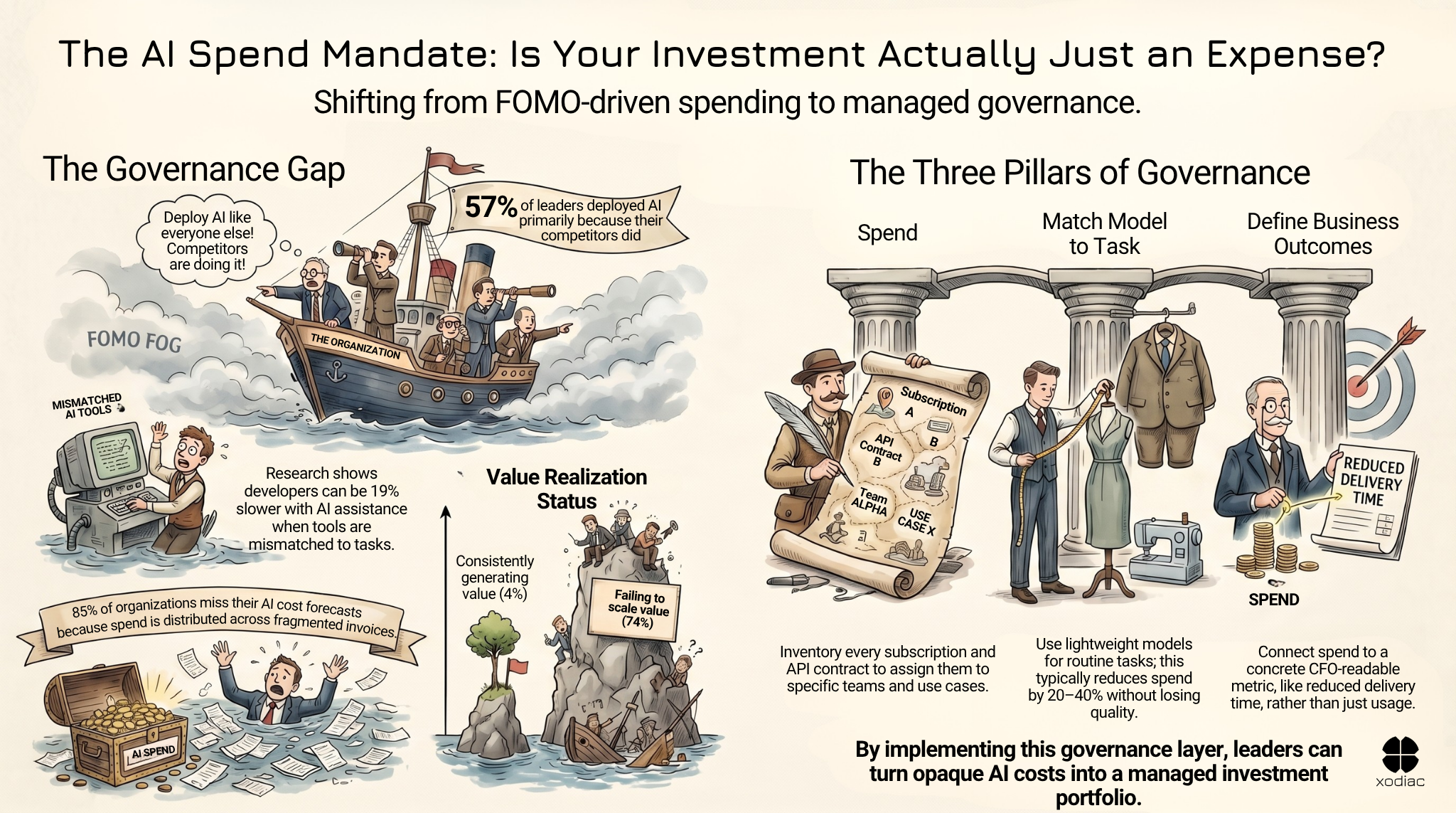
Fear of missing out is driving investment decisions that no one is actually accountable for. The pattern is consistent across industries: an Orgvue survey of more than 1,000 C-suite and senior decision-makers found that 57% of business leaders deployed AI primarily because their competitors had. A WRITER survey of 2,400 global employees and executives found that 75% of C-suite leaders say their company’s AI strategy is “more for show” than real guidance. And 85% miss their AI cost forecasts, according to Mavvrik – by enough that finance teams are asking questions nobody has a clean answer to.
Most organizations got on the AI train. Very few mapped the route.
The problem with FOMO-driven investment
The challenge isn’t that organizations are investing in AI. It’s that most of them can’t answer three basic questions about those investments:
- Visibility: What are we actually spending – broken down by team, tool, and use case?
- Governance: Are we using the right model for the right task?
- Outcomes: Can we draw a line from that spend to a business result that matters?
If you can’t answer all three, you don’t have an AI investment. You have an AI expense.
The AI spend visibility gap
Most organizations have centralized visibility into cloud infrastructure costs. They have dashboards for AWS, Azure, GCP. Finance can see the bill. Engineering can see what’s driving it.
AI spend doesn’t work that way yet. Copilot seats sit on one invoice. OpenAI API calls on another. Perplexity and Claude and whatever new tool the team signed up for last month on personal credit cards that may or may not get expensed.
The spend is distributed, opaque, and growing. And because it grows incrementally – a few seats here, a few API credits there – it rarely triggers the scrutiny that a single large purchase would.
You can’t govern what you can’t see.
The consequences of that opacity are landing at the largest organizations in the world. Microsoft opened access to Claude Code — Anthropic’s AI coding assistant — to thousands of its engineers in late 2025. Less than six months later, Fortune reported that Microsoft had begun canceling most of those direct licenses and moving its engineers to GitHub Copilot CLI. The reason wasn’t performance. It was cost. Nvidia’s vice president of research Bryan Catanzaro put the broader pattern plainly: “the cost of compute is far beyond the costs of the employees.”
The model governance gap
Even in organizations with good spend visibility, there’s a second problem: model selection.
Most teams default to the most capable model available. It’s understandable – the quality is better, the output more reliable. But it’s a bit like buying Lamborghinis for your paper routes. The capability is real. The fit is wrong.
Premium AI models cost 10 to 20 times more per token than lightweight alternatives. For tasks like summarizing a meeting, classifying a support ticket, or generating a first draft for human review, a lightweight model does the job at a fraction of the cost.
Model governance – matching the right model to the right task – is one of the highest-leverage interventions available to organizations right now. Most aren’t doing it systematically.
What happens without it: Uber’s CTO Praveen Neppalli Naga told Fortune that the company burned through its entire 2026 AI coding tools budget in four months. The mechanism was an internal leaderboard that incentivized engineers to use AI tools more — with no corresponding controls on what those tools cost or whether the usage was producing value. Usage went up. The budget ran out. Whether it delivered anything remains a harder question to answer.
The AI ROI outcomes gap
The third gap is the hardest to close: connecting AI spend to outcomes. Simply because most organizations have always struggled with this. Once again, AI amplifies the problems in your existing system.
The scale of the stakes makes it harder to ignore. Goldman Sachs projects that agentic AI will drive a 24-fold increase in token consumption by 2030, reaching 120 quadrillion tokens per month. Inference costs are expected to fall sharply over the same period. The instinct is to read those two numbers and relax: cheaper tokens will offset the volume. Gartner analyst Will Sommer has been direct about why that logic is wrong: “Chief Product Officers should not confuse the deflation of commodity tokens with the democratization of frontier reasoning.” Agentic workloads consume tokens at fundamentally different rates than single-turn queries. The bill won’t shrink just because the unit price does.
METR’s 2025 research measured the productivity impact of AI on experienced developers working on real open-source projects. The result was not what most AI vendors would want you to read: developers completed tasks 19% slower with AI assistance than without. The confidence interval ran from +2% to +39% slower – statistically robust, not a rounding error.
This isn’t an argument against AI. It’s an argument for measuring carefully. The same pattern shows up across engineering pipelines – when teams optimize for AI output volume without redesigning the system around it, the gains don’t flow through to delivery. The bottleneck doesn’t disappear – it moves. The teams in that study were using AI tools on tasks those tools weren’t well-suited for. That’s a governance problem, not a technology problem.
BCG’s research reinforces the gap at scale: 74% of companies are not achieving and scaling value from AI despite significant investment. Only 4% are consistently generating value across functions.
Developer satisfaction scores and PR volume don’t tell you whether value is flowing to the business. They tell you whether developers are using the tool. That distinction matters more than most organizations realize.
GitHub Copilot’s June 1 billing change
On June 1, GitHub Copilot switches to token-based billing. 1 AI credit = $0.01. Different models, different costs. Premium requests metered.
This is a small change with a large implication: for the first time, many engineering leaders will have a bill that shows them exactly what their AI is doing and what it costs. Line by line.
The organizations that benefit from this change are the ones with the governance layer to act on the information. The ones that don’t will have a more detailed invoice and the same three questions unanswered.
This pattern won’t be limited to Copilot. As AI tooling matures, usage-based billing is becoming the norm across the industry. The question isn’t whether your AI spend will get more readable – it’s whether your organization will be ready to do something with what it reads.
Three things worth doing now
You don’t need to wait for June 1. Here’s where to start:
1. Map your spend. Pull together every AI subscription, API contract, and tool your teams are using. Assign it to a team and a use case. If you can’t do this in an afternoon, you have a visibility problem that’s worth fixing before the bill grows further.
2. Set a model selection policy. Even an informal one. Not every task needs the most powerful model. Define the categories of work that warrant premium capability – and the ones that don’t. This single change typically reduces AI spend by 20 to 40 percent without affecting output quality.
3. Name your outcomes. For your three largest AI investments, identify one business outcome you’re tracking. Not a usage metric. An outcome. Something your CFO can read and connect to the investment.
Free download: Is Your AI Spend Earning Its Keep?
The AI FinOps Cheat Sheet maps the 20 metrics every technology leader needs across four dimensions – cost attribution, value signal, efficiency, and governance. Plus five diagnostic questions to ask your team this week.
If you can’t answer most of them, that’s exactly where to start.
The organizations that will look back in 18 months and say AI delivered real value aren't the ones that spent the most. They're the ones that turned AI spend from an opaque bill into a managed investment portfolio.Where to start
Two ways in.
If you want a practical tool to bring to your next leadership meeting, start with the AI FinOps Cheat Sheet above. Download it and work through the five diagnostic questions with your team. You will know quickly where the gaps are.