
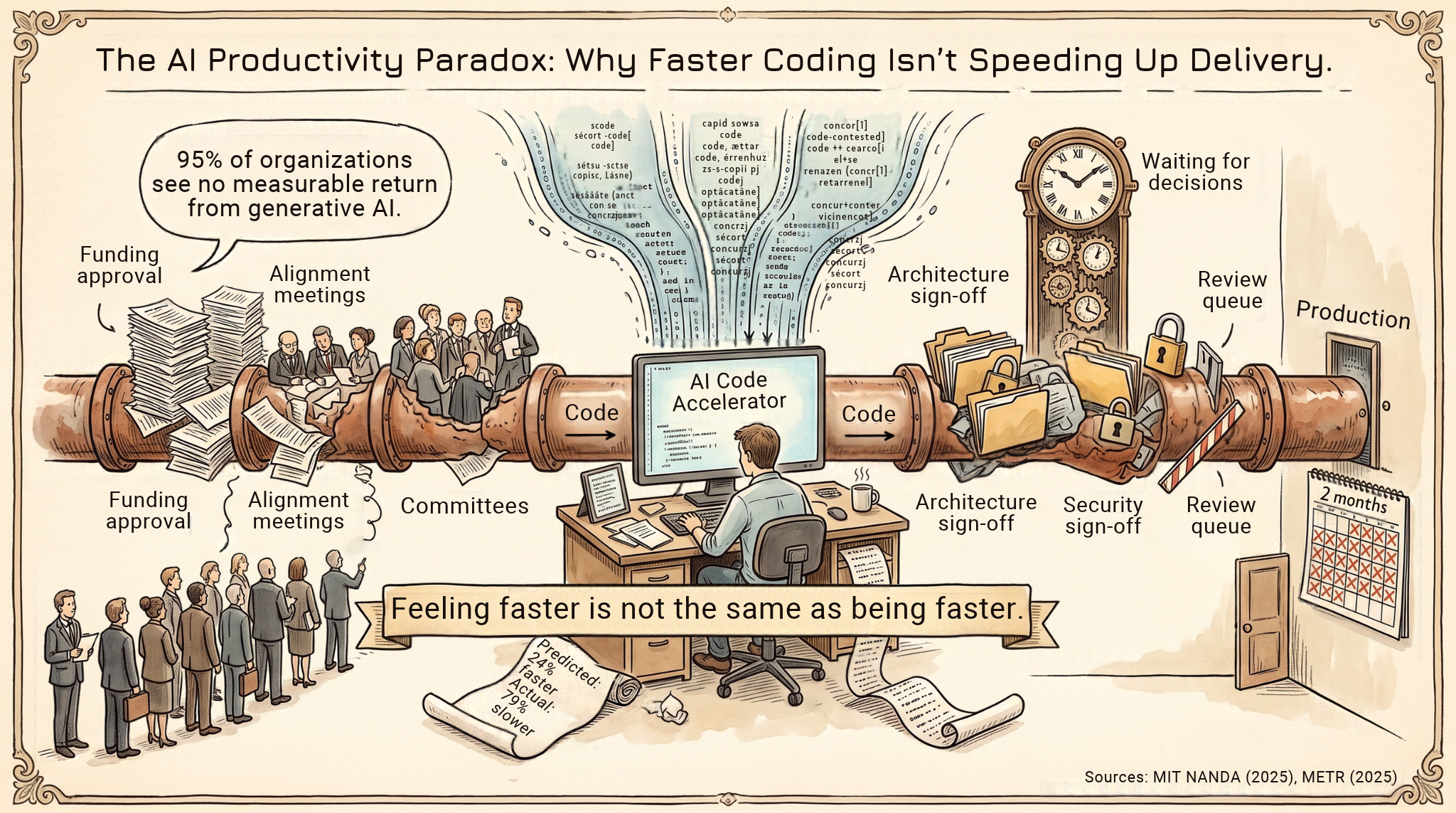
Coding went from ten days to ten minutes. Getting that code to production still takes two months.
Process improvement in the AI era comes down to one discipline: find the step that actually limits your delivery, and change that step before you add AI anywhere else. Most organizations now use AI every day, yet cycle time, cost per outcome, and quality have barely moved. AI sped up the part of the work that used to be scarce, which was writing code. The real time still leaks out through sign-offs, handoffs, queues, and decisions that wait on a few overloaded people. The fix is a small, deliberate method. Map one value stream to find the constraint. Redesign that one step around people, AI, and controls. Prove the result with a 30-day experiment. Below is how each step works, what the research shows, and why the real bottleneck is rarely where your team expects it.
Why AI did not move your numbers
The gap is well documented. MIT's Project NANDA reviewed more than 300 public AI initiatives and found that 95% of organizations are getting no measurable return from generative AI. Most tools improved individual productivity without moving the P&L. One manufacturing COO in the study put it simply: "We're processing some contracts faster, but that's all that has changed." That matches what we see with clients.
One client we work with is a textbook case. Their teams adopted AI coding tools and started producing far more code. Almost none of it reached production faster. Coding went from ten days to ten minutes, and it still takes them two weeks to get anything into production. Honestly, two weeks is short for them. It is closer to two months.
Their coding speed was never what held them back. The system around the code was. Before any change gets built, someone has to get approval to spend money on the idea. Then everyone has to get aligned. Then it goes through multiple committees, an architecture sign-off, and a security sign-off. Add permissions that let only certain people act, and queues between every step.
None of this is new. When coding was slow, these constraints hid behind it. Now that coding has been reduced to minutes, they stand out. The end-to-end process did not get faster. The bottleneck moved elsewhere in the flow.
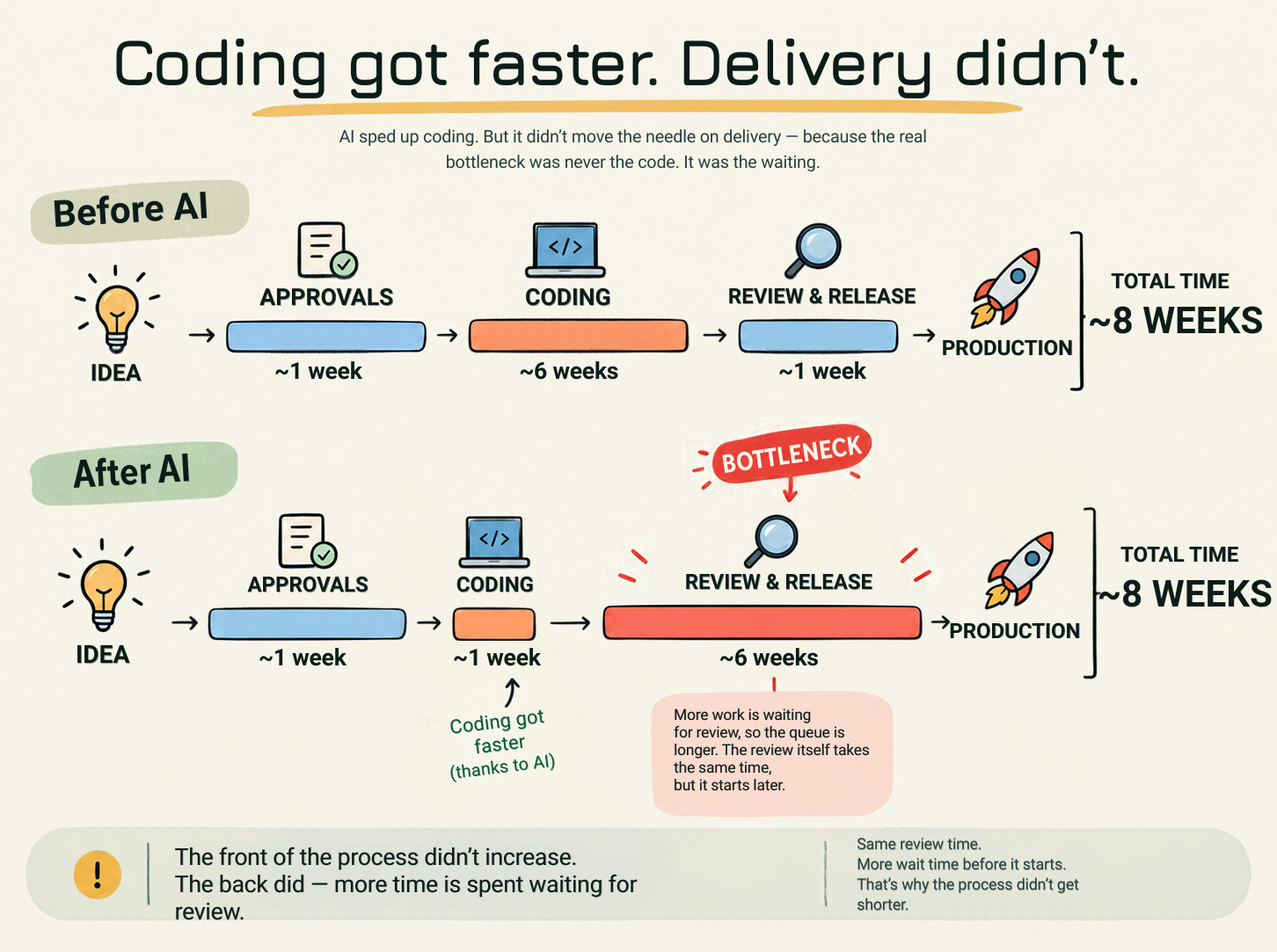
The numbers back this up. Coding was never most of the job to begin with. An IDC report found that application development took up 16% of developers' time in 2024, with most of their time going to operational and supporting tasks. And when AI does speed up coding, the extra volume lands on everything downstream. In Faros AI's research, developers on teams with high AI adoption completed 21% more tasks and merged 98% more pull requests, but PR review time went up 91%. Organization-level delivery metrics like deployment frequency, lead time, and change failure rate showed no measurable improvement. (More on this in Faster Code, Slower Shipping.)
We see what that looks like from the inside. AI-generated code moves so fast that it brings edge cases nobody caught, and those break things further down the line. Source code repositories, CI pipelines, and release processes all have to absorb the extra load. The systems that consume all that new code are creaking under it, whether those systems are people or technology.
Google's DORA research found the same pattern at scale. Its 2025 report, based on nearly 5,000 technology professionals, concluded that AI amplifies whatever is already there. Strong teams get better, and struggling teams see their existing problems intensify. AI adoption now goes hand in hand with higher throughput, and also with more instability: more change failures, more rework, and longer cycle times to resolve issues.
Busier than ever. Zero change in time to value.
There is a subtler version of this, and end-to-end testing is a good example. Building a proper test suite used to take weeks, and keeping it working was painful, because every change to the system broke the tests. So many teams skipped it. Now, with AI connected to a testing tool like Playwright, a team can generate those tests automatically and keep them in sync as the system changes.
That is genuinely good work. It improves quality. But teams end up busier than ever, with the technology doing more than it ever has, and the outcomes of the organization do not move at all. It doesn't save a dime or generate a dime.
Teams often can’t feel this gap. In a randomized trial by METR, experienced open-source developers took 19% longer to finish real tasks with AI tools, despite predicting a 24% speedup. The time went into prompting, reviewing output instead of writing it, and doing more than the task needed. It is one study in a narrow setting, but the lesson travels: feeling faster and being faster are two different measurements.
AI also adds a new constraint of its own. When work moves this fast, people struggle to stay aligned. The context an AI works with has to be understood by the team too, and keeping everyone current is hard. We cover this in What Is Context Engineering.
What process improvement means now
People often ask us what AI changes about process improvement. Our answer usually surprises them. Nothing changes about process improvement, but everything changes about the system you are trying to improve.
The method is the same as ever. See where the challenge is, try something to make it a little less painful, and measure the effect, what changed is the thing you are improving. We like to compare it to going from improving a motorcycle to improving a car. You use the same approach, but the actions are mostly different.
The old moves stopped working for a simple reason. For decades, the whole delivery system was built around one scarce resource: a senior developer who could write good code. Scrum Masters, product owners, business analysts, and most of the process around them existed to protect that person's time. AI can now generate code. Protecting coder time is no longer the most important job in the system, and the critical pieces now sit elsewhere.
That has a practical consequence. If your improvement work only makes small tweaks to the system you already have, you will struggle, because the system itself has changed underneath you. You have to step back and look at the whole flow again.
The most dangerous assumption
Ask us where leaders go wrong most often, and we don't have to think about it: they assume AI will replace their developers. A close second is assuming it will replace their managers.
The appeal is easy to see. If coding is ten times faster, it looks like you need a tenth of the coders. That reading misses where the time actually goes. The constraint was never how many people could write code. Cutting people at a step that was not the bottleneck saves money on paper and leaves delivery exactly as slow, with fewer people left to fix it.
The way out, in brief
At Xodiac, we want to help our customers get real, tangible benefits from their AI investment as fast as possible. We created a service for this, which we call AI Delivery Improvement Sprint.
- Map one value stream to find the step that actually limits delivery.
- Redesign that one step around people, AI, and controls.
- Prove the change with a 30-day experiment against a baseline.
The first step is the one most teams get wrong. We find your constraint (and show you how to do it yourself) in How to Find the Real Bottleneck in Your Delivery Process.
Common questions
What is process improvement? Finding where a workflow loses time, cost, or quality, then changing the part that limits it most. Changes anywhere else feel productive but leave the outcome flat.
What are the stages of process improvement? Identify a process tied to a real outcome, map the current state, find the constraint, redesign that step, and measure against a baseline.
How can AI help with process improvement? By landing on the step that limits the outcome. Anywhere else, the time saved gets absorbed by the approvals, handoffs, and queues around it.
Which process improvement tool has the most impact? The one that finds your constraint. For most teams that is value stream mapping, because it shows where work waits instead of where it feels slow.
What are the common process improvement methodologies? Lean removes waste. Six Sigma reduces variation using DMAIC. Kaizen builds small daily improvements. PDCA gives you a simple test cycle. All of them pay off only when you point them at the constraint.
Where to start
If your AI numbers have gone flat, adding more AI is the wrong next move. Find the one step holding back the outcome, and prove a change to it before you touch anything else. That is the shortest honest path from "we use AI now" to "AI changed the result."
To find the step holding you back, read How to Find the Real Bottleneck in Your Delivery Process. For more on the mechanism behind the flat numbers, read Why AI Adoption Is Disappointing. And if you want to see where your AI investment is getting stuck in delivery, take the 7-minute AI Investment Visibility Check.
About the author Gino Marckx is a Management Consultant at Xodiac, where he helps enterprises improve how they deliver. Over two decades he has guided organizations through the shifts to cloud, to agile, and now to AI, with the same focus each time: change the system so the new technology actually changes the outcome.