
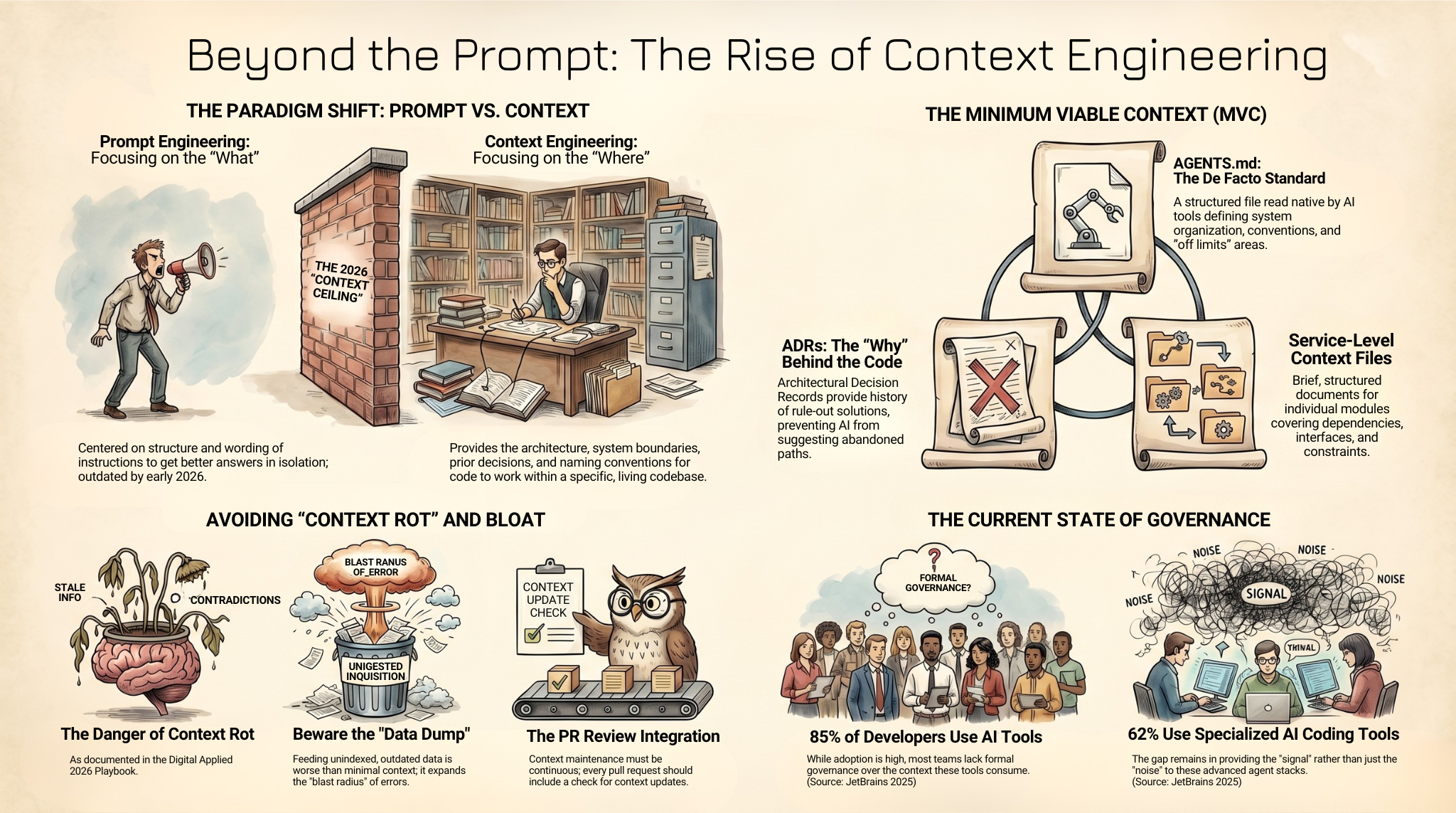
Context engineering is the discipline of giving AI the right information, in the right format, at the right time, so it generates code that fits your system, not just code that compiles.
For the past couple of years, "prompt engineering" was the thing teams were supposed to get good at. Write better questions. Choose better words. Craft the perfect instruction set and your AI would finally do what you needed.
That framing is already outdated.
The teams getting consistent, reliable results from AI-assisted development aren't obsessing over how they phrase requests. They're thinking carefully about everything that surrounds the request - the architecture decisions, the system boundaries, the prior choices, the constraints. They're doing context engineering. This post is a practical guide to what that means and how to do it.
What's the Difference Between Prompt Engineering and Context Engineering?
It helps to be precise about the difference, because they're often conflated.
Prompt engineering is about the question. How you phrase the instruction. The structure and wording of what you ask the model to do.
Context engineering is about everything the model needs to answer well. The architecture of the system it's working within. The decisions that were already made, and why. The constraints it needs to respect. The interfaces it can and can't touch. The naming conventions your team uses. What's changed in the last three months.
Prompt engineering can get you a better answer in isolation. Context engineering is what makes that answer work inside your actual system.
The shift from one to the other happened quickly. Between 2024 and early 2026, teams that were still focused purely on writing better prompts started hitting a consistent ceiling: the output was technically correct but contextually wrong. It didn't fit the codebase. It contradicted prior decisions. It generated interfaces for components that had already been refactored.
The problem wasn't the model. It was the absence of the context the model needed to produce output that actually worked.
Teams that made the shift - that started thinking about context as something to engineer deliberately - stopped getting inconsistent results. Those that didn't are still there, as documented in Digital Applied's Context Engineering Agent Reliability Playbook 2026.
How to Implement Context Engineering: AGENTS.md, ADRs, and Context Files
The minimum viable context setup
Before a team ships AI-assisted code at any meaningful scale, they need three things in place.
AGENTS.md — A structured file that tells AI coding agents how to work within your system. What conventions to follow. What's off-limits. Where things live. How the system is organized. AGENTS.md is now read natively by GitHub Copilot, Cursor, Aider, Devin, and OpenAI Codex; it has become the de facto standard for instructing AI coding agents across the industry. If your team is shipping AI-assisted code and doesn't have one, every agent session starts without knowing the most basic facts about your system.
Architectural Decision Records (ADRs) — ADRs have been around for years. The reason most teams didn't bother maintaining them was that humans would rarely go back and read them anyway. AI agents will - every single time, if they're in scope. ADRs give agents the context behind the decision: not just what was chosen, but why, and what was ruled out. That context is what prevents an agent from confidently suggesting you rebuild something you already tried and abandoned.
Context files per service — At the service or module level, a brief structured document covering what the service does, what it doesn't do, its dependencies, its interfaces, and any known constraints. This is the context the agent needs to make decisions that fit - rather than decisions that technically work but violate boundaries you'd established.
How to structure it
Not all context belongs in one place. Dumping everything into a single large context window is one of the most common mistakes teams make (more on that below).
A working framework: knowledge and know-how belong in skills that agents can reference, specific actions belong in sub-agents with focused context, concrete enforcement rules belong in hooks, and process initiation belongs in commands. Each of these keeps the context window, the total information an AI model can hold and process in a single session, small and the signal clear.
How it stays current
Good context engineering also means thinking about the lifecycle. Create the context, yes. But also: distribute it, maintain it, update it when the system changes, and measure whether it's working.
A practical mechanism: part of every pull request review should be an agent check, what in this change requires context to be updated? If the architecture shifts, if a new service boundary is introduced, if a convention changes, the context update happens as part of the delivery, not after.
Why Context Engineering Fails: Three Mistakes Software Teams Make
Treating it like documentation hygiene
The most common mistake is thinking about context engineering the way most teams think about documentation: something you set up once and update when you feel like it.
Context that isn't maintained degrades. Context rot, the degradation of model performance as context windows fill with stale or contradictory information, is a named, documented failure mode in 2026, as covered by the Digital Applied Context Engineering Agent Reliability Playbook. The model doesn't tell you the context is stale. It uses it anyway.
Dumping unindexed data
The second mistake is thinking that more context is always better.
Feeding an agent a large dump of unindexed documentation, outdated specs, and accumulated notes is worse than a minimal, well-structured context. A bloated context window gives the model more to misinterpret and more to ignore. It expands the blast radius of every bad output - because the model will make choices about what to weight, and those choices may not match yours.
Teams that do this sometimes find they need another AI tool just to navigate the output of the first one. That's not a sign of progress.
Assuming everyone understands what agents actually need
The JetBrains State of Developer Ecosystem 2025 found that 85% of developers regularly use at least one AI tool, and 62% use a specialized AI coding tool. Most have zero formal governance over the context those tools consume.
That gap is significant. It's not just that the context is missing - it's that most teams haven't yet asked the question. They're focused on which tool to use, not on what that tool needs to produce reliable output inside their specific system.
The teams that are getting consistent value from AI-assisted development have asked that question. They've realized that agents will confidently tell you the wrong answer when the context is wrong - not because the model is bad, but because you told it something incorrect, or incomplete, or outdated. In an agent stack where multiple models feed each other, one wrong answer propagates. Garbage in, garbage out - at every layer, at speed.
Context Engineering Is a Team Discipline, Not a Solo Skill
Context engineering isn't a new job title. It's not a specialization to hire for. It's a set of practices that any team shipping AI-assisted code needs to build into how they work.
The good news is that the practices are learnable and the tools are in place. AGENTS.md is standard. ADRs have been around long enough that most teams know what they are. The patterns for keeping context minimal and well-structured are established.
What's missing in most organizations isn't knowledge of these tools - it's the decision to treat context as something that has to be engineered deliberately, maintained continuously, and validated against what's actually in the system.
Context engineering doesn't exist in isolation - it's one of the key shifts in how AI-ready delivery systems are structured. We laid out the full picture in How to Redesign Your SDLC for AI in 4 Structural Shifts. And if you want to go deeper on what context maintenance looks like as an operational practice, not just a technical one, Context Is the New Documentation picks up exactly there.
What does your team's context practice look like today — and is it built to hold up as agents take on more of the work?
If you're looking at your current setup and wondering whether it's enough, Xodiac can help you map what's missing and build from where you are. Book a conversation to start.