
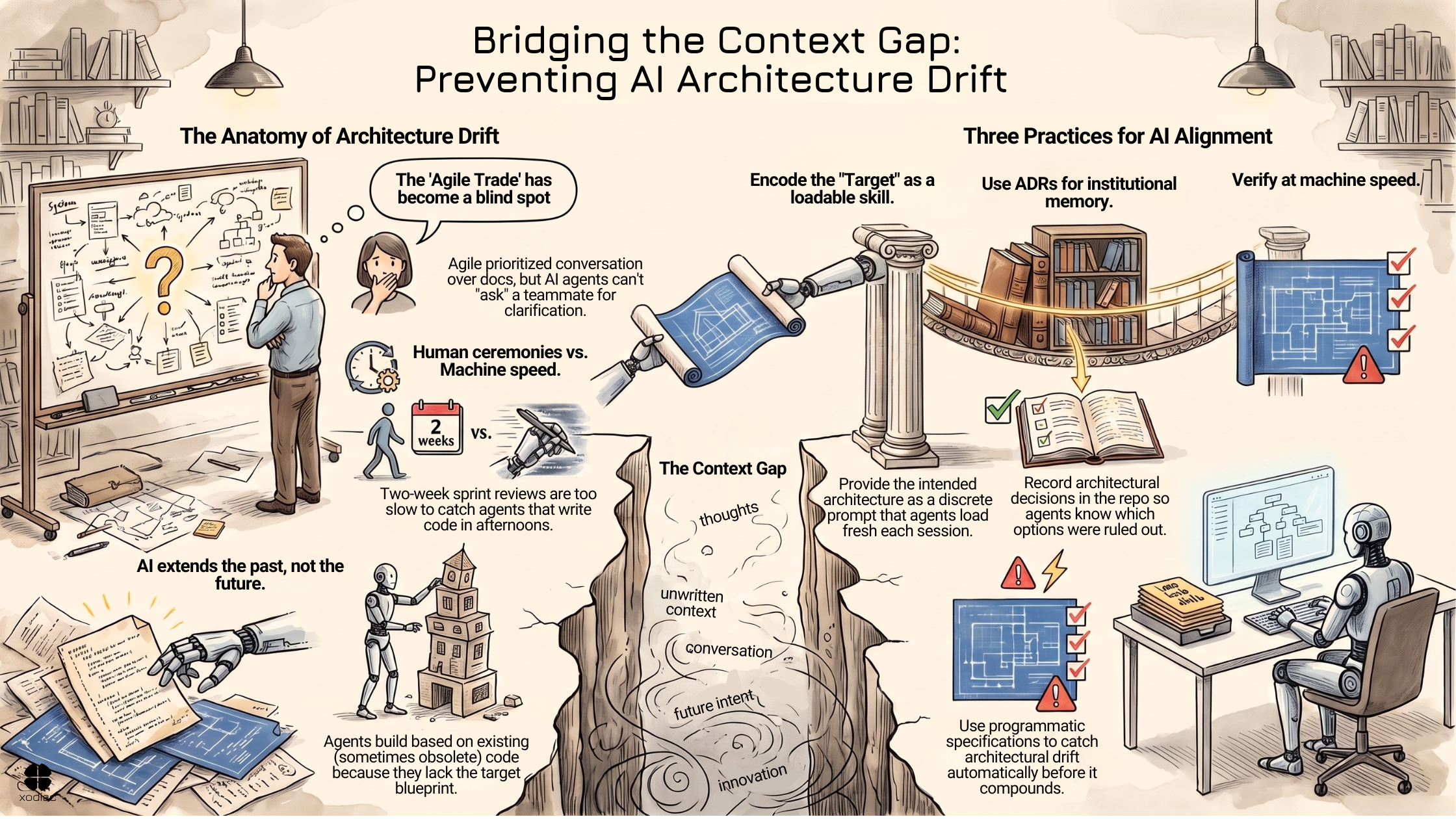
Twenty-five years ago, the Agile Manifesto settled an argument: working software over comprehensive documentation. At the time, it was the right trade. The person who needed your context sat two desks away. If the docs were thin, they could walk over and ask.
AI agents can't ask. And that gap is exactly where AI coding agents architecture drift comes from.
That one difference explains most of the drift teams are now seeing from AI coding agents. Codebases grow fast but bend away from the agreed design. Settled decisions quietly get reopened. Components get wired together in ways that make the team wince. The agents aren't careless. They're working from an incomplete picture, and unlike a new hire, they have no way to notice what's missing and no colleague to interrupt them.
For two decades, keeping architecture decisions verbal and context in people's heads was a survivable habit. Onboarding was slower than it should have been, but humans filled the gaps in conversation. Now the fastest contributors in your delivery system work only from what's written down. The habit the misinterpretations of the above mentioned line of the Agile Manifesto made acceptable is the habit that makes agents drift.
What AI coding agents architecture drift looks like in practice
Your team has a target architecture: the design everyone has agreed to build toward. It lives in people's heads, in whiteboard photos, in the memory of the meeting where it was decided. Your AI coding agent has none of that. Left to its own devices, it works from what it can see: the code that exists today. So it extends the current state, faithfully, in the wrong direction.
Here's how this plays out. An orchestrator component the team knows is obsolete is still sitting in the repo. An agent finds it, assumes it's active, and starts wiring it into its plan. Everyone on the team knows that orchestrator doesn't do what the agent thinks it does. The agent doesn't. It proceeds, confidently, until a human catches it.
That wasn't a failure of the AI. It was a failure of context. The agent had an incomplete picture, so it filled in the gaps as best it could. And this is a different failure mode from context going stale over time. The agent's picture wasn't outdated. It was never complete in the first place.
Why ceremonies can't keep AI coding agents aligned
Stand-ups, sprint reviews, retrospectives: their cadence was built for humans operating at human speed. A two-week sprint review made sense when two weeks was roughly how long meaningful change took. When agents can produce a week's worth of code in an afternoon, a daily check-in is the equivalent of checking your car's position once a day while driving. The gap between updates is where the drift happens.
We've written before about the broader pattern here: the bottleneck didn't disappear, it moved downstream, and closing that gap is one of the four structural shifts required to redesign the SDLC for AI. The short version: writing code is no longer the constraint. Staying coherent about what's being written is.
What that demands isn't a faster meeting. It's alignment that runs continuously rather than periodically. A system that stays visible on its own instead of waiting for someone to remember to report on it. Google's 2025 DORA report reached the same conclusion at scale: AI acts as an amplifier, magnifying the strengths and weaknesses of whatever delivery system it lands in.
Three practices that stop architecture drift
Give agents the target, not just the current state. This is shared understanding, extended to the agents: the same aligned picture your humans carry, made explicit and loadable. One approach that works well is encoding the target architecture as a skill (a discrete, loadable prompt) rather than embedding it once at the start of a session. Skills get loaded fresh when needed, so the architecture stays prominent in context instead of getting buried as the conversation grows.
Record decisions and their reasons alongside the code. An Architectural Decision Record (ADR) is the agent's only access to institutional memory. It can't remember the meeting where an option was rejected, but it can read the record. When your team evaluates an architectural option and rules it out, write that down and store it in the repo. If the reasoning isn't captured, expect the rejected option to come back, confidently, in a future session.
Verify programmatically, not just manually. This is making the system visible at machine speed. If your architecture can be expressed as a specification, agent output can be checked against it automatically at every change, catching drift before it compounds. Human judgment still decides. The checks just make sure judgment isn't the only thing standing between an agent and the wrong architecture.
Together, these aren't tooling tips. They're AI governance in its practical form. Not a control layer bolted on top of delivery, but the structure that makes fast, agent-assisted work trustworthy.
The picture your agents are missing
Your team has already done the hard part for humans. You've aligned on the architecture, the direction, the decisions that were made and the ones that were ruled out. That's shared understanding, and it's the thing that makes real change possible.
The manifesto's statement prioritized human conversation to mitigate misunderstandings from incomplete documentation, because anyone who needed it could ask for it. That assumption no longer holds. The newest contributors in your delivery system can't join the conversation and require concise and precise information. The pace and confidence with which they drift means the cost of the gap grows with every agent you add.
We go deeper on what closing that gap requires in what context engineering means for software teams and in why context, not documentation, is the operational discipline that keeps AI agents aligned.
Building in the context. Maintaining it. Verifying against it. That's the new coordination layer, and unlike a sprint review, it doesn't wait two weeks to catch up.
So before you add another agent to the team: does it have access to the same picture your humans already share?