
You have a CLAUDE.md. You update it when something obviously breaks. What you don't have is a way to know it's wrong before it causes a problem.
That gap is where stale context in AI development does its real damage, not in catastrophic failure, but in plausible output that's subtly wrong. An AI coding assistant refers to a function by a name you stopped using three months ago. A suggestion violates an architectural decision you made last quarter. Code compiles and looks reasonable, until someone who knows the system points out it can't work that way anymore.
The pattern shows up constantly: an agent calling things by names nobody has used in months, referring to functions that no longer exist, pulling data out of a spec that was retired weeks ago. That's invisible context debt, accumulating silently until AI amplifies it.
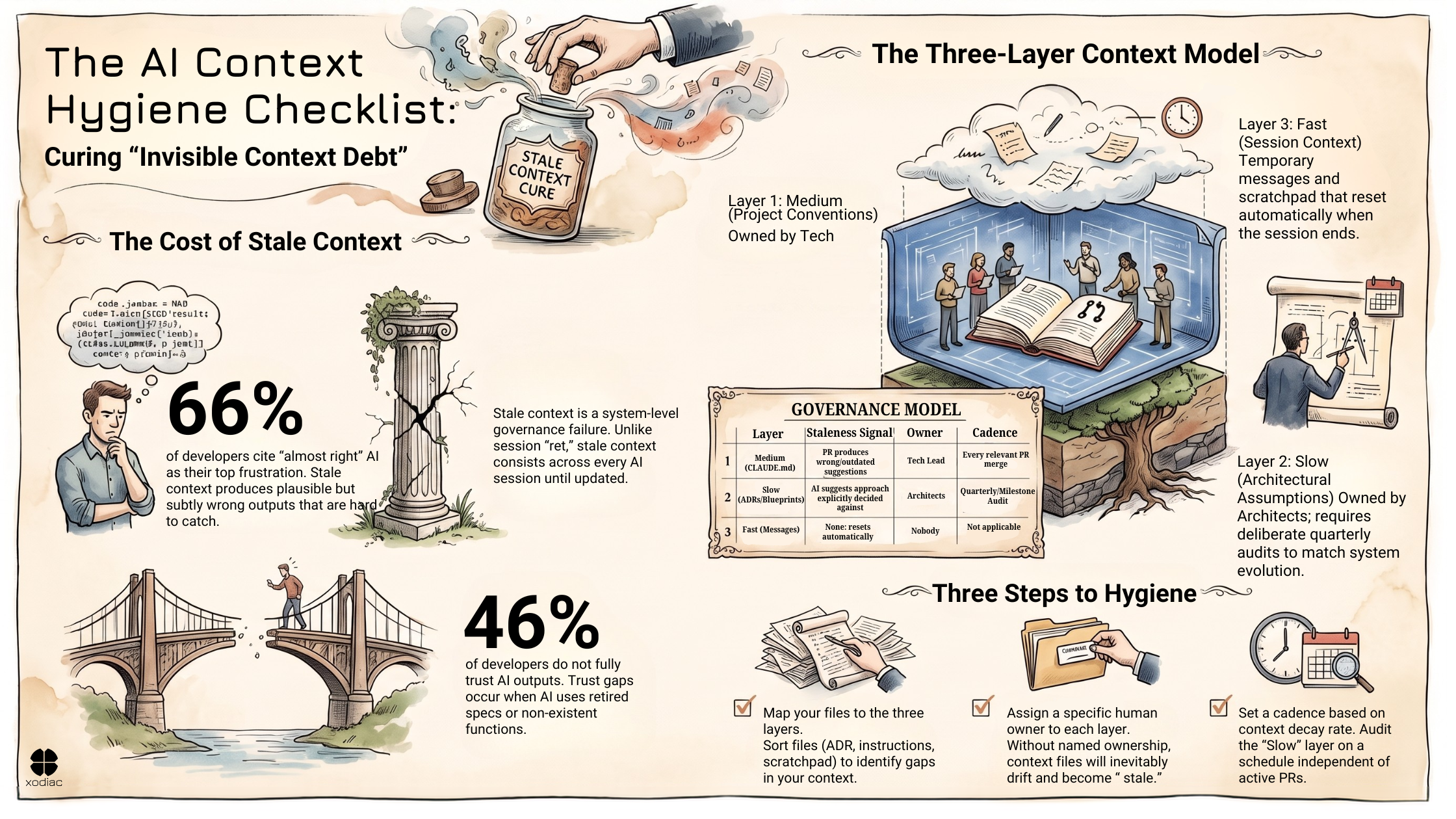
The stakes are real. 46% of developers say they don't fully trust AI outputs (Stack Overflow 2025). Developers report feeling 20% faster but show 19% slower performance in controlled conditions (METR 2025). A Faros AI study of 10,000+ developers across 1,255 teams found more code being produced but no improvement in delivery velocity (July 2025), the same pattern behind why AI adoption keeps disappointing. These numbers aren't a tooling problem. They're a context hygiene problem inside every delivery system, and the gap closes when context is accurate.
The frustration is specific, too. Stack Overflow's 2025 survey found that 66% of developers cite "AI solutions that are almost right but not quite" as their biggest frustration with AI tools, not AI that fails obviously, but AI that fails plausibly. That's precisely the failure mode stale context produces.
If this framing is new, the companion piece on the Context Delivery Lifecycle covers the underlying argument in full. This post is the operational output: a layer-aware checklist for keeping context current across your team.
What Stale Context Actually Looks Like in Practice
Stale context in AI coding is the gradual divergence between your context files and the system they describe. The assistant isn't ignoring your conventions. It never learned they changed. Accurate context files create shared understanding of what the system is and how the team works — shared understanding that extends to every AI session, not just the ones a senior engineer oversees.
Two failure modes often get conflated. Context rot is session-level degradation — output quality declining as a conversation accumulates artifacts, contradictions, or noise. Start a new session and it clears. Stale context is a system-level problem: it persists across every session until someone updates the files. Session rot is an inconvenience. Stale context is a governance failure.
The cheapest signal that something has gone wrong: outdated means it was one way and things changed. Missing means it never described something it needed to. Both produce output that looks plausible, sounds confident, and violates a constraint the AI had no way to know about. This isn't a hallucination problem. The model is doing exactly what you asked. The context file told it the wrong thing.
Not All Context Files Age the Same
This is where most AI governance advice breaks down. A checklist that says "keep your context files updated" treats all files identically. They aren't.
Different layers of context have different context decay rates, and the review cadence that's right for one layer actively wastes effort on the wrong things. Treating them identically is how governance fails: you spend time on the fast layer while the slow layer silently goes wrong in the background.
The three-layer model below gives each layer the specific treatment it needs — and makes the system visible in a way a single flat checklist cannot.
The Fast Layer - Session Context
What lives here: session messages, tool calls, ephemeral scratchpad files (temporary working files created during a session).
Staleness signal: none. This layer resets automatically when the session ends.
Owner: nobody, by design.
Cadence: not applicable.
Tools and skills: Help manage what gets pulled into the session, what gets summarized, what gets checked, and what gets acted on. They reduce session drift, but they do not eliminate it.
The fast layer is not trivial, but it is temporary. Session context still needs good operating discipline: clear prompts, careful retrieval, relevant tools, and active pruning of noise. What it usually does not need is persistent governance ownership, because the session expires. When the session ends, the accumulated context clears with it. Governance energy is better spent on the durable layers below, where stale context persists across every future session until someone fixes it.
The Medium Layer - Project Docs and Conventions
What lives here: CLAUDE.md, AGENTS.md, RULES.md (AI instruction files that define how the assistant should behave in this project), API references, dependency constraints, ways-of-working files, team conventions.
Staleness signal: a PR (pull request) produces a suggestion that's wrong in a specific, repeatable way. A teammate asks "why did the AI suggest X?" and there's no good answer. The agent applies a pattern the team has moved away from, consistently and confidently.
Owner: tech lead, or whoever owns the team's working agreements.
Cadence: triggered by PR, not scheduled.
Tools and skills: Skills, repo instructions, CLAUDE.md, AGENTS.md, command files, and project conventions define how agents should work repeatedly across sessions. These need PR-triggered updates.
No PR should merge without an agent checking whether the change has context implications — whether what was just shipped changes what future sessions need to know. Every feature delivery is also a context delivery obligation. That makes medium-layer review cheap: the agent does the analysis, and the review happens when the work happens.
One important boundary: what belongs here is genuine project convention. What doesn't belong here is anything you want reliably enforced. An LLM will not reliably follow process instructions in the context window (the active working memory available to the AI within a single session), no matter how clearly they're written. For enforcement, use deterministic hooks and tools. Context files are for understanding; hooks are for enforcement.
The Slow Layer - Architectural Assumptions
What lives here: architecture decision records (ADRs — documented records of architectural choices and the reasoning behind them), architectural blueprints, capability descriptions, system vision documents, team constraints, explicit out-of-scope boundaries. The slow layer documents the systemic constraints the AI needs to respect: architectural decisions, explicit boundaries, and commitments that predate the current sprint. Maintain both a vision document (future state) and a concept document (present state) — conflating them produces output that's valid for the vision but wrong for the system as it currently exists.
Staleness signal: the AI suggests approaches the team explicitly decided against, consistently, across developers using the same tooling. Inconsistency despite identical CLAUDE.md files usually traces here — the ADRs are absent or contradict the current system.
Owner: engineering manager or architect. This layer needs someone with enough system context to recognize when documented architecture no longer matches what exists.
Cadence: deliberate audit, not triggered by PRs.
Tools and skills: Architecture docs, ADRs, domain boundaries, system maps, and “do not touch this” constraints need scheduled review and authority signals. Tools can enforce some of this, but the content still needs ownership.
When the Slow Layer Goes Stale, a New Session Won't Fix It
Usually because the conventions live in the slow layer and haven't been updated. Start a new session and nothing improves, because the problem is in the file, not the conversation.
This is also the layer where explicit rules still get broken. One team had a rule written in plain language in their AI instructions file: never edit a migration file that already exists. The AI broke it anyway. Explicit context reduces the odds of a violation. It does not eliminate them. For non-negotiable constraints, the answer is deterministic enforcement — hooks, tests, policy checks — not clearer writing in the context window.
Invisible context debt accumulates here not through active decay, but through the gap between what the documentation says and what the system has become. A PR-level check doesn't surface it. Time and system evolution do. The audit question is not "did we change anything?" — it's "does this still describe what we built?"
Three Steps to Keeping Context Current
By treating context files as first-class engineering artifacts, versioned, owned, and updated at a cadence matched to each layer's context decay rate. Here is the process:
Step 1: Map your context files to their layer.
Go through every file your team gives to AI assistants and sort them: session scratchpads (fast), CLAUDE.md / AGENTS.md / convention docs (medium), ADRs and architecture blueprints (slow). If something belongs in the slow layer but has no file at all, that's your first gap.
Step 2: Assign an owner per layer.
Medium layer: tech lead. Slow layer: engineering manager or architect. Fast layer: nobody, by design. If a layer has no named owner, it will not get reviewed.
Step 3: Set a cadence per layer, not per file.
Medium: at every PR that touches team conventions. Slow: a deliberate audit on a schedule, quarterly or at a milestone, independent of PRs. The audit question for the slow layer is not "did we change anything?" It is "does this still describe what we built?"
Here is the full reference:
Layer | What lives here | Staleness signal | Owner | Cadence |
|---|---|---|---|---|
Fast | Session messages, ephemeral notes | None, resets automatically | Nobody (by design) | Not applicable |
Medium | CLAUDE.md, AGENTS.md, API references, conventions | PR produces wrong suggestion; teammate asks "why did AI suggest X?" | Tech lead | At PR merge when relevant files change |
Slow | ADRs, architecture blueprints, vision/concept docs, out-of-scope boundaries | AI suggests approaches team decided against; inconsistency across devs | Engineering manager or architect | Quarterly or at milestone, deliberate audit |
What is the difference between context rot and stale context?
Context rot refers to session-level degradation, output quality declining as a conversation accumulates. Stale context refers to system-level degradation, context files that no longer accurately describe the codebase. This post addresses stale context. It is the harder problem because it does not self-correct when you start a new session.
Context governance is not a single file you maintain. It is a system, one where different layers change at different speeds, require different owners, and give different signals that they've gone wrong. The system that catches slow-layer drift is not the same system that catches medium-layer drift, the same logic behind redesigning an SDLC for AI in structural shifts rather than patches. Building both is what makes AI context hygiene work.
Map your context layers before you map your review schedule. Who owns the slow layer on your team right now? If the answer isn't immediate, that's the layer to start with.
Further reading:
- The Bottleneck Didn't Disappear. It Moved
- The Four AI Development Risks Every SDLC Was Built to Prevent
- AI Burnout: The People Who Said Yes First Are Paying the Price
- AI Spend Governance: Why Most Technology Leaders Can't Answer the Three Questions That Matter
- How to Measure AI ROI: The Outcomes Chain Framework