
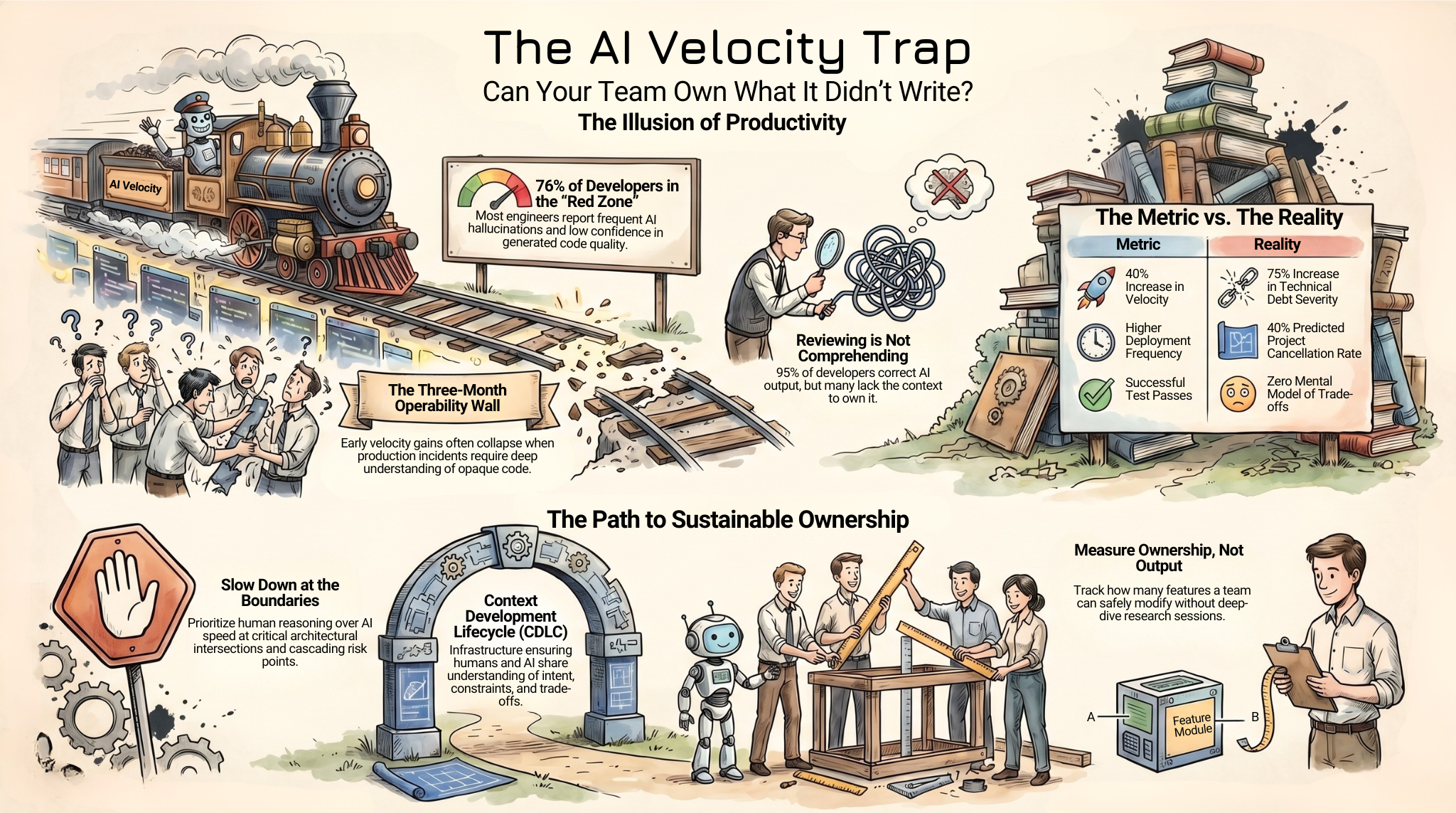
Your velocity metrics look fantastic. You shipped 40% more code this quarter than you did last year. Deployment frequency is up. Cycle time is down. The AI-assisted development workflow is working exactly as promised.
Then something breaks in production.
It takes your team six hours to figure out which AI-generated module caused it. It takes another eight hours to understand what the code actually does. It takes another day to find someone who can safely modify it without breaking something else.
By then, you've lost a customer. You've lost trust. And you're starting to understand a problem that didn't show up in your velocity metrics: AI-generated code operability. Your team doesn't own the code anymore.
According to Qodo's State of AI Code Quality 2025 report, 76% of developers fall into what Qodo calls the "red zone," experiencing frequent AI hallucinations and low confidence in AI-generated code. The incident above isn't an edge case. It's the pattern.
The Operability Problem Arrives Late
Here's the pattern we're seeing across organizations adopting AI-assisted development:
Months 1–2: Everything feels amazing. Velocity is up. Code is shipping. The AI tools are doing exactly what they promised.
Month 3: The first operational problem surfaces. A module that passed review, passed tests, and passed your quality gates starts behaving unexpectedly in production. It's not broken in the way you'd expect. It's not crashing or throwing errors. It's just not what anyone on the team fully understands.
Your team reviews the code. It's technically correct. The logic is sound. The tests pass. But nobody built a mental model for why the code works this way. They didn't architect it. They didn't reason through the trade-offs. They reviewed it and approved it because the tests passed and the linter was happy.
As practitioners have noted, "reviewing AI-generated code is fundamentally different from reviewing human-written code, yet teams haven't adjusted their practices accordingly."
There's a reason this gap is so persistent: the AI itself doesn't flag it. The code looks confident. The suggestions arrive without hedging. There are no error messages for "I generated this without full context about your system."
AI is always ignorantly confident. It produces output that looks authoritative regardless of whether it has what it needs to get the decision right. That confidence is a feature when the context is good. It's a liability when it isn't.
Now someone has to own that code. Modify it. Defend it in a post-incident review. Explain it to a new engineer six months from now.
And they can't, because operability was never part of the equation.
Velocity Isn't the Same as Delivery
Organizations measure delivery by velocity: lines of code per sprint, features shipped per quarter, deployment frequency. These are the metrics that look good in standup.
But velocity isn't delivery. Delivery is code that your team can own, modify, and operate safely at 2 a.m. when something breaks.
Operability is invisible in sprint reviews. You don't measure it. You don't plan for it. You don't allocate time for engineers to build mental models of what the AI just generated. According to the Sonar State of Code Developer Survey 2026, nearly all developers (95%) spend time reviewing and correcting AI output, and 59% describe that effort as moderate or substantial. The review is happening. The comprehension isn't.
So when the operability debt comes due (and it will, usually around month three), it comes due as a surprise.
The surprise usually takes the form of a production incident. Or a feature that should have taken two days to modify but takes two weeks because nobody understands what the code is actually doing. Or an engineer quitting because they've spent the last month fixing code they didn't write and don't understand.
Meanwhile, Gartner predicts over 40% of agentic AI projects will be cancelled by end of 2027 due to escalating costs, unclear business value, and inadequate risk controls. The pattern extends into AI-assisted development: when the system can't absorb what AI is generating, the investment stops delivering returns.
The Diagnostic Question Every Team Should Ask
Before your next sprint planning, ask your team this: Can everyone on this team confidently own the code that AI generated this sprint?
Not "Did it pass review?" Not "Do the tests pass?" Not "Is the code technically correct?"
Can your team own it? Can they modify it safely? Can they explain it to someone else? Can they defend the architectural decisions embedded in it?
If the answer is anything less than a clear yes, the code isn't done. The risk is just deferred.
What Good AI-Generated Code Operability Looks Like
Teams that get this right do three things:
- They slow down AI generation when it matters. Not everywhere, but at the architectural boundaries. Where a decision by the AI affects multiple systems. Where a bug would cascade. Where the operational risk is real.
- They build comprehension into the workflow. The AI doesn't just generate code, it has to explain the trade-offs. And the engineer reviewing it has to understand those trade-offs well enough to make a real decision: "Yes, this is the right approach" or "No, regenerate with these constraints."
- They measure operability, not just velocity. How many features shipped this quarter can the team confidently own right now? How many would require a deep-dive to understand? How many are sitting behind one engineer who's the only person who gets them? These are the early warning signs of operability debt. The organizations seeing real returns from AI understood their delivery system before deploying into it, and they measure system health, not just output.
Context as Infrastructure: The CDLC Approach
What these teams are actually building is called Context Development Lifecycle (CDLC), and it's becoming central to how mature organizations think about sustainable AI-assisted delivery.
CDLC is infrastructure for operability. Where the traditional SDLC ensures code is built correctly, CDLC ensures code is built in context: the AI generating it, the humans reviewing it, and the systems running it all share understanding of intent, constraints, and trade-offs.
Context means four things:
- What the code is supposed to do
- Why this approach was chosen
- What assumptions are embedded in the code
- Who on the team can modify it safely
Without CDLC, you have code that works until it doesn't. With CDLC, your team owns what AI built because they understand the context in which the decisions were made.
This is where the three-month window becomes critical. The first three months are when you're still building context. After that, context decays. People leave. New engineers join who didn't make the original decisions. The code becomes increasingly opaque.
As Tracy Bannon argued at QCon London, "Fix your SDLC before adopting Gen AI." AI-generated code conflicts with DevSecOps principles of traceability, auditability, reproducibility, and explainability when no governance layer exists at the right points. CDLC is the operability response to that challenge: the governance discipline that keeps AI-generated code in context, owned, and modifiable.
It's not a tool. It's not a process. It's a discipline: maintain the context about what you're building so AI can help without fragmenting your system.
The 3-Month Window Is Closing
You have about three months before the operability question becomes impossible to ignore. Three months before the velocity advantage starts converting into maintenance cost. Three months to decide: are we building systems we can operate, or are we just deferring risk?
Meanwhile, Forrester's Technology & Security Predictions 2025 found that 75% of technology decision-makers will see their technical debt rise to a moderate or high level of severity by 2026, driven by the rapid development of AI solutions adding complexity to IT landscapes. The three-month window is closing faster than most engineering organizations realize.
This is why incremental improvement doesn't close the gap. You can add more reviews, more checklists, more gates, and still find yourself in the same place three months later. The operability problem isn't procedural. It's structural.
You can't evolve your way out of a system designed for a different kind of code production. That's not a Kaizen problem; the idea that continuous improvement applied to the existing process will eventually get you there. It's a Kaikaku problem: a fundamental redesign. The SDLC that served your team when humans wrote every line needs to be rebuilt, not patched, for a world where AI is writing a substantial share of it.
The choice is yours. But it has to be intentional. Because the AI doesn't know the difference.
Can your team own what it built? That's the question that matters.
If the answer isn't a clear yes, let's talk.
We work with engineering and delivery leaders to assess operability risk and build the CDLC practices that make AI-assisted development sustainable. The three-month window is real, and it moves fast.