
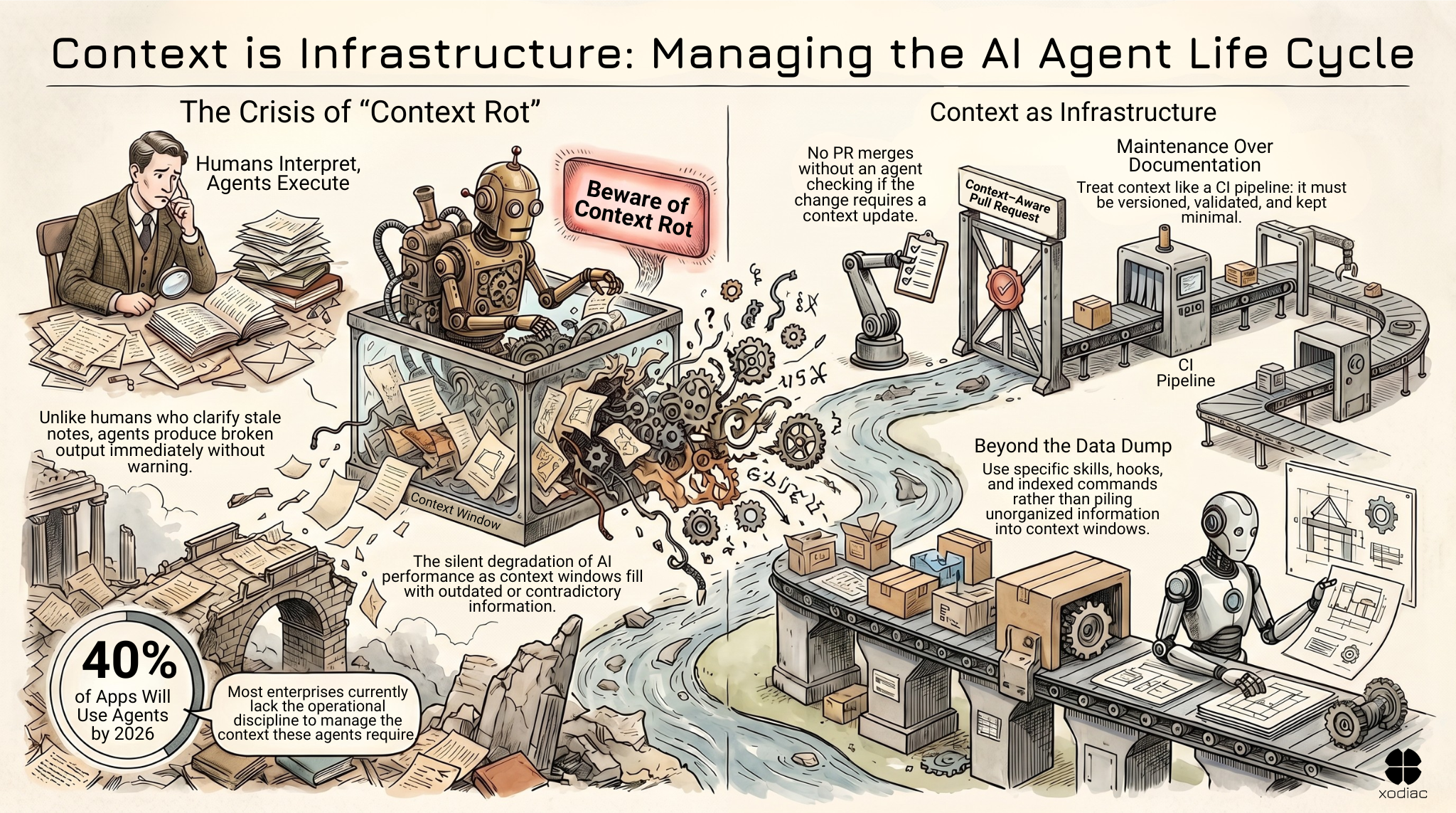
Documentation was always meant to serve humans. It assumed a reader who could browse a wiki, interpret outdated notes, ask a colleague for clarification, and fill in the gaps with judgment built over years.
AI agents don't work that way.
They consume context at the moment they generate code. They don't browse the wiki. They don't ask a colleague. They take what they're given and produce output accordingly - at speed, at scale, and with complete confidence in whatever they've been told. Which means the quality of what you get depends entirely on the quality of what you provide.
Documentation was always a bit fragile. Stale docs were a nuisance - someone would notice, update them eventually, and life would go on. Stale context is a different problem. It doesn't slow you down with confusion. It produces broken output, consistently, before anyone realizes what's wrong.
What Happens When AI Agents Work From Stale Context
Here's what it looks like in practice.
A few months ago, a team was using AI agents to build out interfaces for a system that had gone through several architecture changes. The agent kept generating code that called functions that no longer existed - and naming things using conventions the team had moved away from months earlier. Nobody could figure out why.
The answer was simple, and painful: the agent was pulling from an old spec. A new spec existed. But both were accessible, and nothing in the system told the agent which one was current.
The agent didn't make a mistake. It did exactly what it was told to do. It was told to build from a spec, it found a spec, and it built. The problem was the context - not the model, not the prompt.
This is the shift that most teams haven't fully absorbed. With documentation, humans could adapt. They could notice that something felt off, cross-reference, ask around. With AI agents, none of that happens. Bad context doesn't produce a warning. It produces output, bad output.
The Digital Applied Context Engineering Agent Reliability Playbook (2026) has a name for what happens next: context rot — the degradation of AI model performance that occurs as context windows fill with stale, outdated, or contradictory information, causing consistent output errors that don't announce themselves. As context windows fill with stale information, model performance degrades - not obviously, not all at once, but steadily and at scale.
Why AI Agent Context Must Be Maintained Like Infrastructure
Most teams still treat context like documentation. Something you create, store somewhere, and update when you remember to.
That's the wrong mental model.
Context is infrastructure. It has to be maintained, versioned, and validated - the same way you'd treat a CI pipeline or a deployment configuration. When it breaks, things downstream break. When it's outdated, everything that depends on it produces unreliable results.
Teams that understand this treat context as a first-class operational concern. They keep it minimal and indexed. They use the right tool for the right job: skills for reusable knowledge, sub-agents for specific actions, hooks for enforcement rules, commands for kicking off processes. They don't just pile information into a context window and hope the model sorts it out.
That last part matters. Feeding an AI agent a large dump of unindexed information isn't better than a focused, well-maintained context - it's worse. A large context window gives the model more to misinterpret. The model will choose which parts to weight and which to ignore. It will forget things you marked as important. The blast radius of every bad output gets bigger.
The failure mode that shows up most often isn't that teams don't create context. It's that they stop there. Most teams create context files and never touch them again — they distribute, maintain, update, and measure as afterthoughts, if at all. The rest of the lifecycle doesn't happen.
How to Build Context Updates Into Your Pull Request Flow
When your architecture changes, two audiences need to know: your engineers, and your AI agents. Right now, not at the next sprint review.
Engineers are used to this problem, even if they don't always solve it well. There are processes - pull requests, code reviews, team syncs - that nominally keep people aligned. AI agents have none of that. They start every session with only what you give them.
So the question becomes: how do you make context updates part of the delivery rhythm, not an afterthought?
One concrete answer: no pull request gets merged without an agent checking whether anything in the change requires an update to context. What changed? What does that mean for future sessions? What would an agent need to know to work effectively with this code three months from now?
That review becomes part of the PR. Not optional. Not "if you remember." It's the same discipline as requiring tests - it happens as part of the definition of done.
Beyond that, periodic audits matter. Code changes fast. Context often doesn't keep up. If a module has gone through significant changes but its context documentation hasn't been touched, that's a signal worth investigating. You need something outside the PR flow that checks whether context is aging well.
Gartner projects that 40% of enterprise applications will feature task-specific AI agents by the end of 2026 - up from under 5% in 2025. Most of those teams don't yet have a clear answer to who owns context and how it stays current.
That's not a model problem. It's an operational discipline problem.
Context Management Is a Delivery Task, Not a Documentation Task
None of this is technically complicated. The tools are available. The practices are known. What it requires is a shift in how teams think about their obligations when they ship code.
Documentation was always supposed to serve the humans who came after you - the person who would inherit your codebase, pick up the work, try to understand what you built and why. Most teams did this imperfectly, and the cost was friction, confusion, and the occasional late-night debugging session.
Context has to serve both humans and AI agents. The bar is higher, because agents are less forgiving. They don't ask for clarification. They act on what they're given.
Updating context isn't documentation hygiene. It's a delivery task.
What does your team's current context practice look like and is it built to serve both the humans and the agents working inside your delivery system?
If you're not sure whether your current context practice would hold up under agent load, that's worth a conversation. Book a call with Xodiac to work through what your delivery system actually needs.
We explored the shift from process documentation to system documentation, and what that means for AI-assisted delivery, in How to Redesign Your SDLC for AI in 4 Structural Shifts.