
Plenty has been written about why you should never link OKRs to compensation, and we made that case in the first post of this pair. Almost nothing has been written for the leader reading it too late.
Maybe you inherited the setup. Maybe it seemed reasonable at the time: people hit targets, people get paid, what could be cleaner? Either way, you're now watching the consequences. Key results that are always achievable. Teams that quietly negotiate their targets downward. A goal-setting process that produces paperwork instead of ambition. Everything stays green on the outside while nothing underneath actually moves. You know the linkage was a mistake. The real question is what to do about it.
Step one is to decouple OKRs from pay
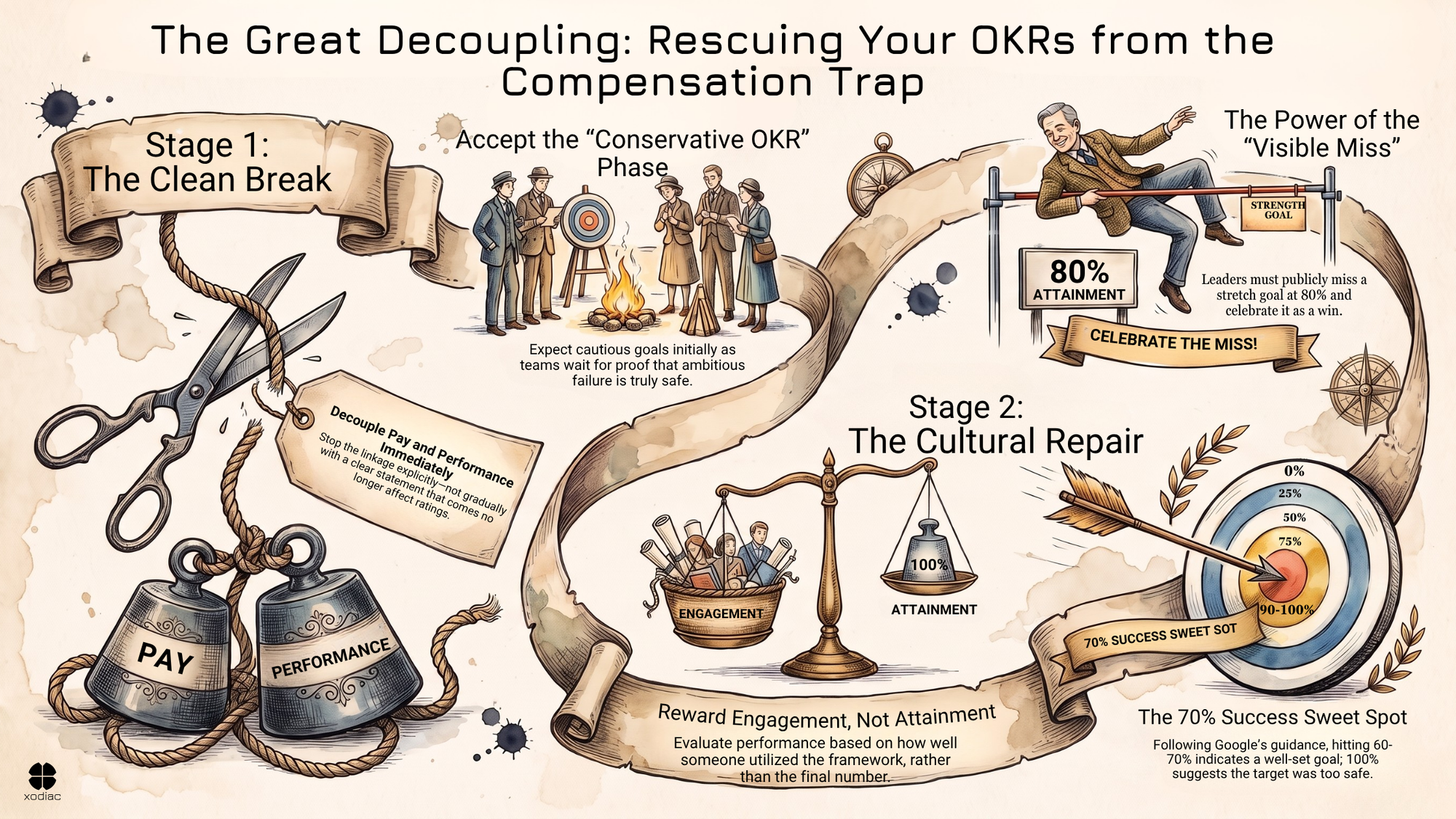
Stop it. Decouple OKRs from compensation, now, and say so explicitly. Not gradually, not "we're reviewing the incentive structure." A clear statement: OKR outcomes no longer affect anyone's pay or rating.
This step is necessary but nowhere near sufficient, because the damage was never the policy. The damage is what the policy taught your people.
Trust is the actual repair
Every quarter the linkage existed, your organization learned a lesson: ambitious goals are dangerous here. That lesson doesn't un-learn on announcement day. People have seen policies change and change back. They'll keep writing safe key results until they see evidence that safety is no longer required.
So expect conservative OKRs after you decouple, and don't penalize them. This is the mistake that restarts the damage: a leader announces the new era, sees cautious goals, and starts pressuring teams to "show more ambition." All that proves is that OKRs are still being judged. The caution isn't resistance. It's memory, the brain doing exactly what it's built to do, predicting risk from experience. Give it room, and give it time.
Leaders go first, and miss in public
Trust rebuilds on demonstration. The single most powerful move available to you costs nothing and terrifies most leadership teams: set a genuinely ambitious key result at the leadership level, miss it, and celebrate the miss in front of everyone.
Here is what that looks like in practice. You set a key result that represents what you actually want to achieve, you pace it honestly, and you land at 80%. You call that a win in front of the whole organization, and you treat it as one.
That number isn't arbitrary. On a well-set stretch goal, Google's own scoring guidance treats roughly 60 to 70% as the target, and a consistent 100% as a sign the goal was too safe to begin with. A celebrated 80% tells your people the bar was set honestly. Do that once and people notice. Do it for a few quarters and the organization starts to believe the rules have actually changed. There's no memo that achieves what one visibly celebrated 80% achieves.
Change what gets rewarded, not whether
Decoupling pay from OKR outcomes doesn't mean performance conversations ignore OKRs. It means the conversation changes shape.
Ask: “Did you engage with your OKRs? Was the work of the quarter focused on the initiatives they prioritized? Were they helpful? How would you improve them?” Someone who gave the process an honest try and has thoughtful criticism of it is showing exactly the behavior you want more of, whether or not the numbers landed. Someone who refused to engage at all is having a different kind of performance conversation. Reward the behavior and the effort. Leave the number out of it, because the number belongs to the strategy, the market, and factors nobody in the room controls.
One caution for team-level rewards: shifting from individual bonuses to team-level recognition softens the worst distortions, but any reward contingent on hitting the number will eventually bend the number. The safe ground is rewarding engagement, not attainment.
Do not switch frameworks to escape the history
There's a tempting shortcut: quietly retire OKRs and introduce something new. A fresh framework, a fresh start, no baggage.
It doesn't work, and the reason is uncomfortable. Your organization didn't learn "OKRs are unsafe." It learned "goal frameworks here end up deciding my pay." If you burned OKRs, why would anyone trust you with the next framework? The new system inherits the old suspicion on day one, minus the credibility you'd have earned by repairing the first one honestly.
Rebuilding where you are is slower and better. It's also the only version your people will actually believe.
How long does this take
Longer than a quarter. Probably longer than you'd like. An organization that spent years learning to protect itself needs sustained, boring, repeated evidence that the rules changed: leaders missing stretch goals publicly, cautious OKRs going unpunished, engagement being rewarded while numbers go unmentioned. This is the slow work of rebuilding psychological safety, and there's no way to compress it. There is only starting earlier.
A question worth sitting with
When was the last time a leader in your organization publicly missed a goal and called it a win?
If no example comes to mind, that's your baseline. Your people have never seen ambition rewarded with anything but risk. The first celebrated miss will matter more than any policy you write this year.
Learn to set OKRs that actually stretch
Most OKR problems are not motivation problems. They are design problems, and design problems can be fixed once you can see them. That is what we teach.
Our next OKR Practitioner course runs online over two half-days, starting September 9, 2026, live from 9:00 AM to 1:00 PM. It's accredited by the OKR Institute, tuition is CA$1,200 and includes the certification exam, and it counts for 7 PDUs or 7 SEUs toward your renewals.
You'll leave able to write key results that measure progress instead of fear, and to keep them out of the compensation trap this post describes.