
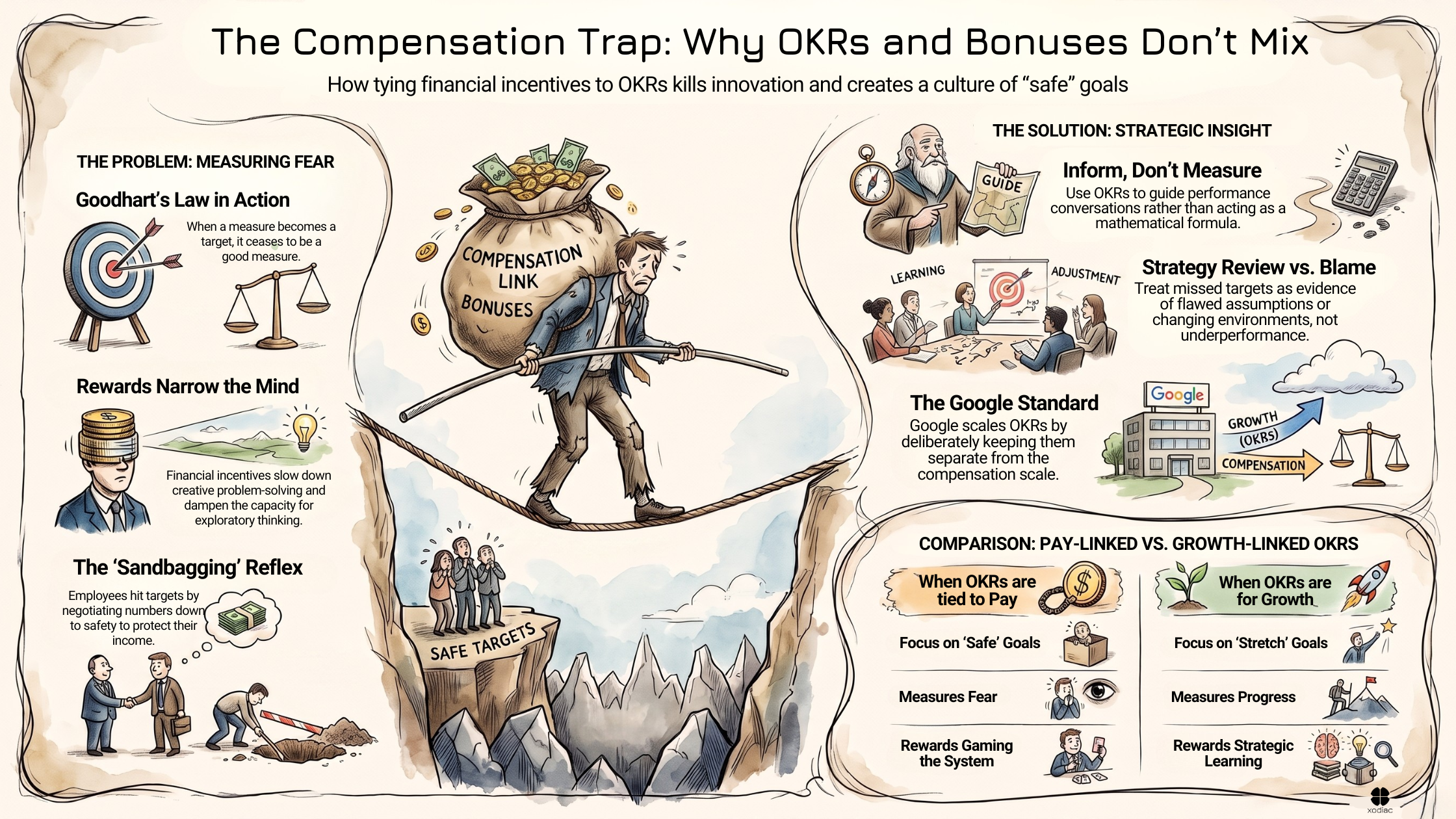
Your OKR stopped stretching. The key results your teams submit are polished, professional, and completely safe. Every quarter, most of them land in the green. And somehow nothing about the business feels any different.
If you've tied bonuses or performance ratings to those OKRs, it's worth looking at what the system is telling you. The framework is doing exactly what you configured it to do.
The employee who refused to stretch
We were coaching a team on OKRs. When we got to stretch goals, one team member said no. Not out of cynicism or lack of ambition. She'd watched goal frameworks get used to justify holding bonuses back, and she didn't trust that this one would be different. So she'd be writing key results she knew she could hit. All of them.
Her reaction was completely rational. That's the part worth sitting with. She wasn't gaming the system; she was reading it correctly. The system said: your money depends on these numbers. She responded the way any sensible person responds to that message. The problem is rarely the person who sandbagged. It's the system that made sandbagging the smart move. This is what treating OKRs as performance targets does to people.
And it compounds. In another organization, we watched directors set a program's dollar target by moving the number up and down until it sat in a range everyone was confident they could reach. Then they published it and tracked progress toward it. A financial institution told departments to spend half their budget on Agile projects, so one manager relabeled his largest project "Agile" and hit the target without changing a thing. Different companies, same lesson. This pattern is old enough to have a name. Goodhart's Law: when a measure becomes a target, it stops being a good measure. When money or judgment rides on a number, people optimize the number.
Why the number was never a measure of performance
Here is the reasoning that makes our position firm rather than fashionable.
Whether a key result lands depends on far more than any individual's effort. The initiatives behind an OKR are assumptions: calculated, evidence-based, but assumptions. A marketer can run an excellent campaign targeting a new customer segment and still miss the number, because the strategy misjudged the segment, or a partner slipped, or tariffs arrived and the market stopped investing. The result reflects strategy quality and environment as much as execution, which is really the difference between outcomes and outputs.
Pay people on that number and you're paying them for macroeconomics. They know it, which is why they stop aiming high the moment the link is made.
There's a second cost. OKRs are built for transformational work: the things that move the organization to a new state. But if compensation flows through OKRs, then everything an employee does must appear in an OKR, including all the business-as-usual work that keeps the lights on. The framework bloats into a task list, and the one thing it was designed to do (focus ambition) is gone.
There's a cognitive layer underneath this, too. A promised reward changes how the brain approaches a problem, and the research on motivation has shown the pattern for decades. In the classic candle problem experiment, people offered a cash reward solved the creative task noticeably slower than those offered nothing. A later meta-analysis of 128 studies found performance-contingent rewards reliably undermine intrinsic motivation. "If you do this, then you get that" narrows attention and speeds up routine work. It also quietly works against the exploratory thinking that stretch goals exist to invite. So the moment you attach money to an OKR, you dampen the very capacity the stretch was meant to draw on.
The implication
This is why we do not recommend keeping OKRs once they're wired to pay. It isn't that the idea is wrong. It's that the framework can't function under those conditions. You'll carry the full cost of running OKRs (the planning, the cadence, the reviews) and see little of the value, because every number in the system has already been quietly negotiated down to safety. At that point the honest question isn't how to fix the OKRs. It's whether they're still worth running at all.
And if the link to pay is already in place, decoupling it is its own piece of work. We walk through exactly how in the companion to this post, Your OKRs are already tied to pay. Now what.
What to do instead of tying OKRs to pay
Let OKRs inform performance reviews without becoming the measurement. This is not a fringe view. Google, where OKRs were scaled, deliberately keeps them off the compensation scale for exactly this reason. The distinction is practical, not philosophical.
In a performance conversation, ask: “Did you focus your effort on the initiatives the OKRs prioritized, or did the quarter's work drift somewhere else? Did you engage with the OKRs honestly? Were they helpful? How would you improve them?” Those questions surface something a number never can: whether the person worked on what mattered and worked it well.
Then keep the other conversation separate. When a key result is missed, the question isn't who underperformed. It's which assumption turned out different from reality, and what changed in the environment. That's a strategy review, and it makes the organization smarter. Blame only makes it quieter.
If a CTO gives us two minutes, it comes down to one line: OKRs can inform a performance review. They were never built to be the measurement.
A question worth sitting with
Look at the key results your teams committed to this quarter and ask honestly: if every bonus implication disappeared tomorrow, would these numbers get more ambitious?
If the answer is yes, your OKRs are measuring fear, not progress. That's worth knowing, because fear is a system setting. And system settings can be changed.
Learn to set OKRs that actually stretch
Most OKR problems are not motivation problems. They are design problems, and design problems can be fixed once you can see them. That is what we teach.
Our next OKR Practitioner course runs online over two half-days, starting September 9, 2026, live from 9:00 AM to 1:00 PM. It's accredited by the OKR Institute, tuition is CA$1,200 and includes the certification exam, and it counts for 7 PDUs or 7 SEUs toward your renewals.
You'll leave able to write key results that measure progress instead of fear, and to keep them out of the compensation trap this post describes.