
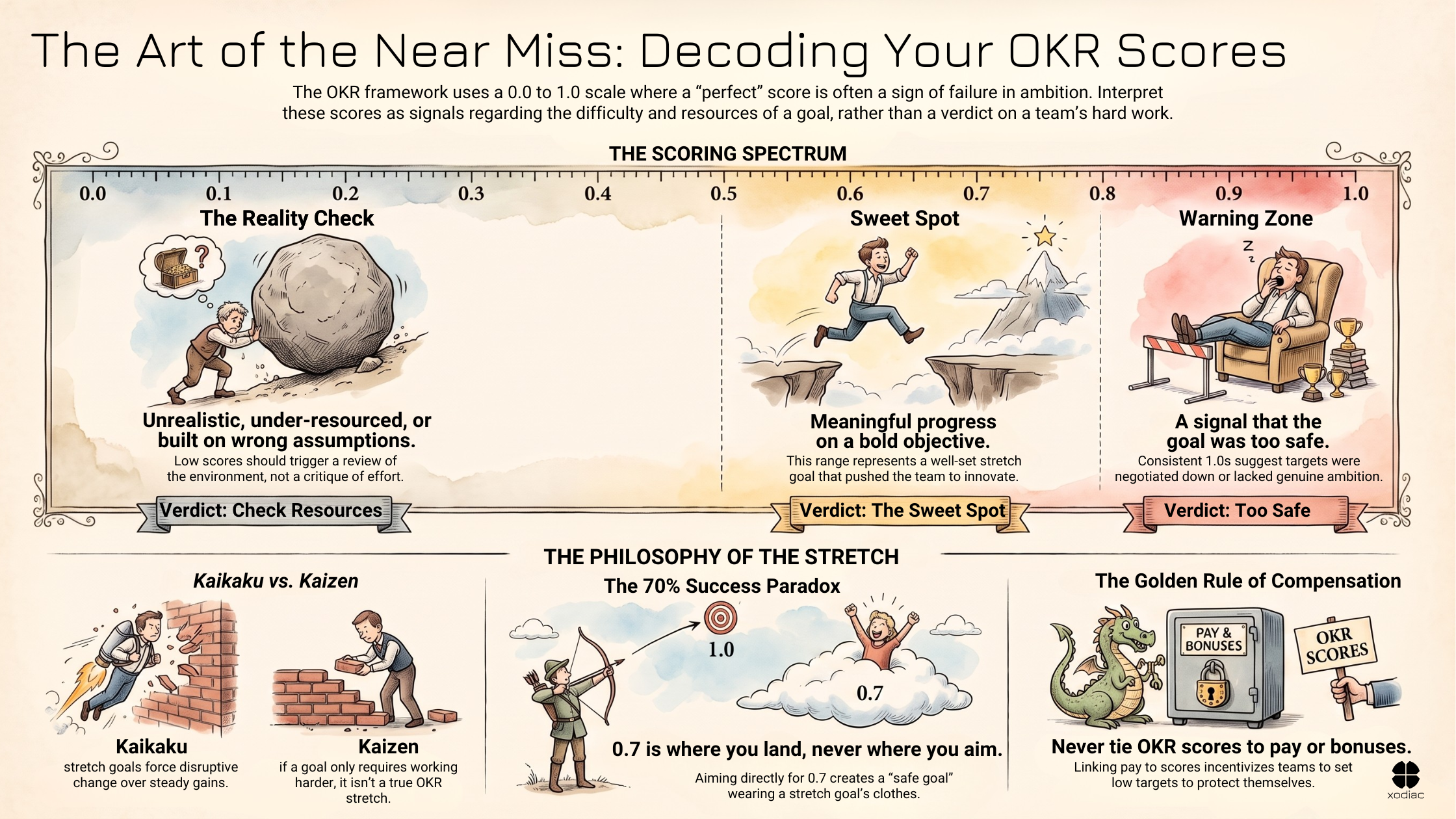
Your team just closed the quarter at 70 percent of its biggest OKR. Your gut reads that as a miss. Everywhere else at work it would be one: hit 70 percent of a KPI, a budget, or a delivery date and you have some explaining to do. But an OKR is the one number that is supposed to land around there. That is the whole reason the score exists.
Read that 70 the wrong way and you quietly train your team to aim lower next quarter. Read it right and it tells you something useful: the goal was a real stretch, and you still made strong progress on it. On the 0.0 to 1.0 scale most teams borrow from Google, that 70 percent is a 0.7. A consistent 1.0 means the goal was too safe. Below 0.4 usually means it was unrealistic or under-resourced. The score grades the goal, not the person.
Why 70 percent is a strong result, not a near miss
A key result is supposed to stretch. You set it at a level you are not sure you can reach, precisely so it pulls more out of the team than a comfortable goal would. Land it every time and the goal was not stretching anything. It was a task you already knew you could finish, dressed up as an ambition. This is why Google's own scoring guidance treats 0.6 to 0.7 as a healthy result and a steady 1.0 as a warning sign.
There is a subtlety here that most advice gets wrong, though. You cannot aim for 0.7 directly. Set out to score exactly 70 percent and you have just built a safe goal wearing a stretch goal's clothes. The 0.7 is where you land, never where you aim.
Think about setting a goal to run a half-marathon. You don't train by saying, "I'll stop at 5K." You commit to the full 13.1 miles, and you push yourself as far as you realistically can. Maybe race day doesn't go perfectly, you hit a wall, the weather's rough, whatever, and you cross the line at mile 10 instead. You didn't fail. You just ran 10 miles further than you would have if you'd set out to jog a 5K in the first place. You can still be proud of that distance. You just refused to cap yourself at the start.
Key results work the same way: you reach for the whole objective and treat landing at 70 or 80 percent as the success it is.
And it only reads as a success when the people looking at the score understand why the stretch is there. Plenty of teams set a genuinely audacious goal, land at 70 or 80 percent of something most organizations would never have attempted, and get treated as if they had failed, because leadership was still reading the OKR as a target to be met rather than a stretch to be pursued. That maturity gap is the difference between an OKR that motivates and one that quietly teaches everyone to aim lower next time.
A real stretch asks for new thinking, not more effort
Here is why the sweet spot matters beyond the number. A goal you can only reach by a real stretch usually cannot be reached by working harder at all.
Two terms from the Toyota Production System capture the difference. Kaizen is continuous improvement: small, steady gains on how you already work. Kaikaku is disruptive change: stopping to rethink the work itself. If your objective only needs Kaizen, a comfortable goal will do. If it needs Kaikaku, no amount of working a little harder or a little faster gets you there. The stretch is what forces the rethink. It pushes a team to innovate, to stop doing things the way they have always done them, because the old way plainly will not reach the goal. Strip the stretch out and you strip out the reason the OKR existed.
There is a limit, though: stretch, but don't break. Set the goal so far past reach that nobody believes it and it stops motivating anyone, because a target people privately write off is a target they never really aim at. The sweet spot is the goal that makes a team focus and rethink while still leaving them able to believe they can make it happen.
What each score band is telling you
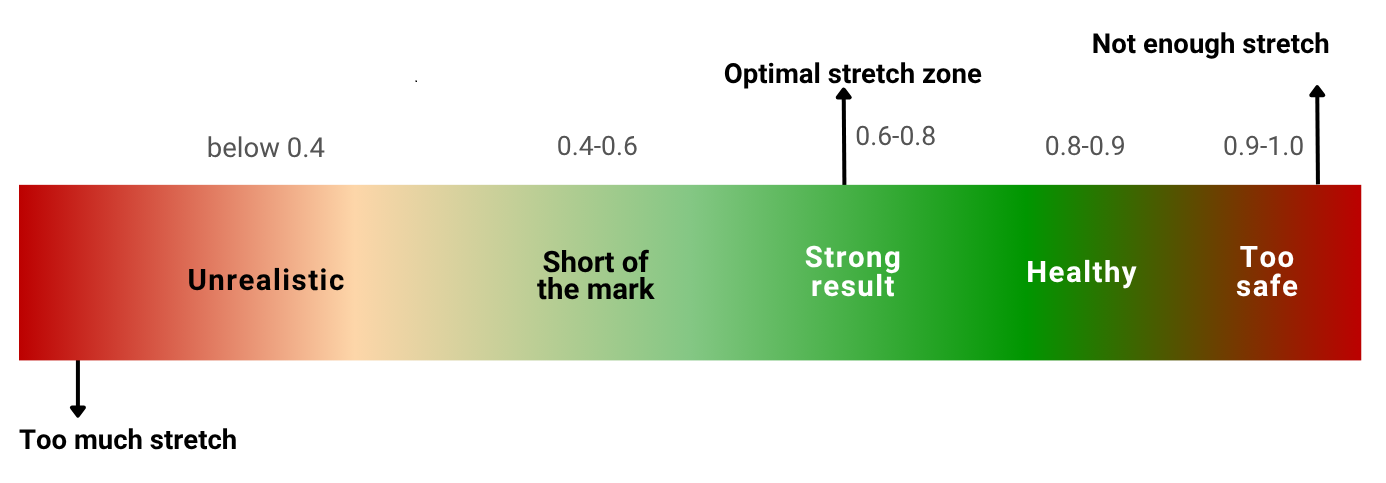
The number is only useful when you read it as a signal about the goal, not a verdict on the people. Here is what the common bands mean.
0.9 to 1.0 (90 to 100 percent), consistently. The goal was too safe. Either it was set conservatively, or someone negotiated it down to a number they knew they could hit. Both are worth a conversation. Neither is a cause for celebration.
0.8 to 0.9 (80 to 90 percent). A real stretch that mostly landed. Healthy, if slightly cautious. Fine now and then, worth watching if it becomes the pattern.
0.6 to 0.8 (60 to 80 percent). The sweet spot. Meaningful progress on a bold objective, with room left to learn from. This is what a well-set stretch looks like.
0.4 to 0.6 (40 to 60 percent). Ambitious, and short of the mark. Not automatically a problem. The question is why, and the answer is almost never "the team did not try."
Below 0.4 (under 40 percent). The goal was probably unrealistic, under-resourced, or built on an assumption that turned out wrong. Look at the goal and the environment before you look at the effort.
Notice what none of these bands tell you: how hard anyone worked. That information is not in the score, and it never was.
What to ask when a key result lands at 0.5
When a key result comes in at half, the instinctive question is who is responsible. That is the wrong question, and asking it teaches everyone to protect the number next time. The better questions are about the goal and the world around it.
Is this even the right key result? Does it truly represent progress toward the objective, or is it swayed by so many outside factors that the number gives you false positives and false negatives? Was the strategy sound? Did the market move mid-cycle? A 0.5 can mean the goal was unrealistic, the strategy was wrong, the metric was noisy, or the environment shifted underneath you. In every one of those cases the win is the insight. Without the OKR you would have kept pouring effort into an initiative without ever knowing whether it was working. So a 0.5 is worth celebrating too, not because you reached it, but because you learned something you can act on. That is the difference between outcomes and outputs, and it is why the honest question after a miss is which assumption turned out different from reality.
Turn up the heat without burning the team
A stretch goal only motivates inside the right environment. Picture the team's effort as heat under a pan. Too little, and everything sits frozen, or simmers down into a bland mush where no single person's contribution comes through. Too much, and it burns: pressure, fear, internal competition, blame. The right amount brings out each person's strengths while the team makes something none of them could alone.
The trap is reading "turn up the heat" as "turn up the pressure." Leaders who do get the burn every time. And the burn shows up most clearly in how a low score gets read. When a result lands at 0.4, the most common reaction is also the least useful: the team must be lazy, or incompetent, or both. It is worth being blunt about how often that is the only lens a leader brings to a low number. But a low score is almost never a motivation problem. If you want a team to perform, give them direction they can act on. Direction is strategy, encoded in the objective and its key results. Drawing a line in the sand you cannot explain how to reach, then blaming whoever misses it, is not direction. It is abdication with a number attached.
The one condition that ruins the whole scale
All of this holds together only as long as the score stays off people's pay. Attach a bonus or a rating to the number and a 0.5 stops being information and becomes a judgment, good or bad. People respond exactly as you would expect. They negotiate targets down to what they are confident they can hit, and every score drifts toward safety. Off the compensation scale, the score answers one honest question: are we making progress toward the goal? On it, the score answers a different one: how do I protect myself? We make the full case in the fastest way to kill your OKRs is to pay people for them, and what to do if you have already made that link in OKRs are already tied to pay, now what.
Score the progress, then review the goal itself
A score tells you how far you got. It does not tell you whether the goal was any good. Those are two different reviews, and most teams only ever do the first, if they do any at all. They set the goals, work toward them, then quietly forget them and write a fresh set next cycle.
At the end of a cycle, look at each OKR twice. Quantitatively: how much progress did we make toward it? Qualitatively: was this a well-built objective, did it focus us, did it push us to think differently? The second review is where next quarter's goals get sharper, and it is the piece almost everyone skips.
A question worth sitting with
Look at last quarter's scores. If most of them landed at 0.9 or higher, the comfortable read is that your teams are excelling. The more useful read is that your goals stopped stretching, and the scores are telling you so.
Were those high scores real success, or safe goals? Which story is truer is worth knowing, because a goal that is too safe is a setting you can change.
Frequently asked questions
Is a 70 percent OKR score good or bad? On the standard 0.0 to 1.0 OKR scale, 0.7 usually means the goal was a real stretch and the team made strong progress on it. A consistent 1.0 is more often a sign the goal wasn't ambitious enough.
What does a 0.6 to 0.8 OKR score mean? This range is generally considered the sweet spot for a well-set stretch goal: meaningful progress on something genuinely ambitious, with room left to learn from what didn't get finished.
Should OKR scores be tied to performance reviews or pay? No. Once a score affects compensation, people set targets they're confident they can hit, and every future score drifts toward safety instead of reflecting real progress.
Learn to set OKRs that actually stretch
Most OKR problems are not motivation problems. They are design problems, and design problems can be fixed once you can see them. That is what we teach.
Our next OKR Practitioner course runs online over two half-days, starting September 9, 2026, live from 9:00 AM to 1:00 PM. It is accredited by the OKR Institute, the certification exam fee is included, and it counts for 7 PDUs or 7 SEUs toward your renewals. CA$1,200.
You will leave able to set key results that land in the sweet spot on purpose, and to read a score as the signal it was built to be, not a verdict on your team.